December 30. 2020 - 6 min. reading time
Smart metering: energy-efficient and cost-cutting
Setting an important milestone for the energy transition in an environmentally friendly and sustainable way with smart metering systems.
by Christian Schäfer

Everyone has already had to deal with the situation at home: once a year, you receive a request to read the meter readings of the consumption meters and transmit them to the metering point operator.
At the latest when the annual statement from the energy supplier or the landlord's service charge bill arrives in the letterbox, people start to think about energy costs and energy efficiency.
A large number of meters are used in large properties. If the values also have to be recorded several times a year, this quickly increases the time required and therefore the costs for the property owner. Transmission errors due to manual reading should not be neglected.


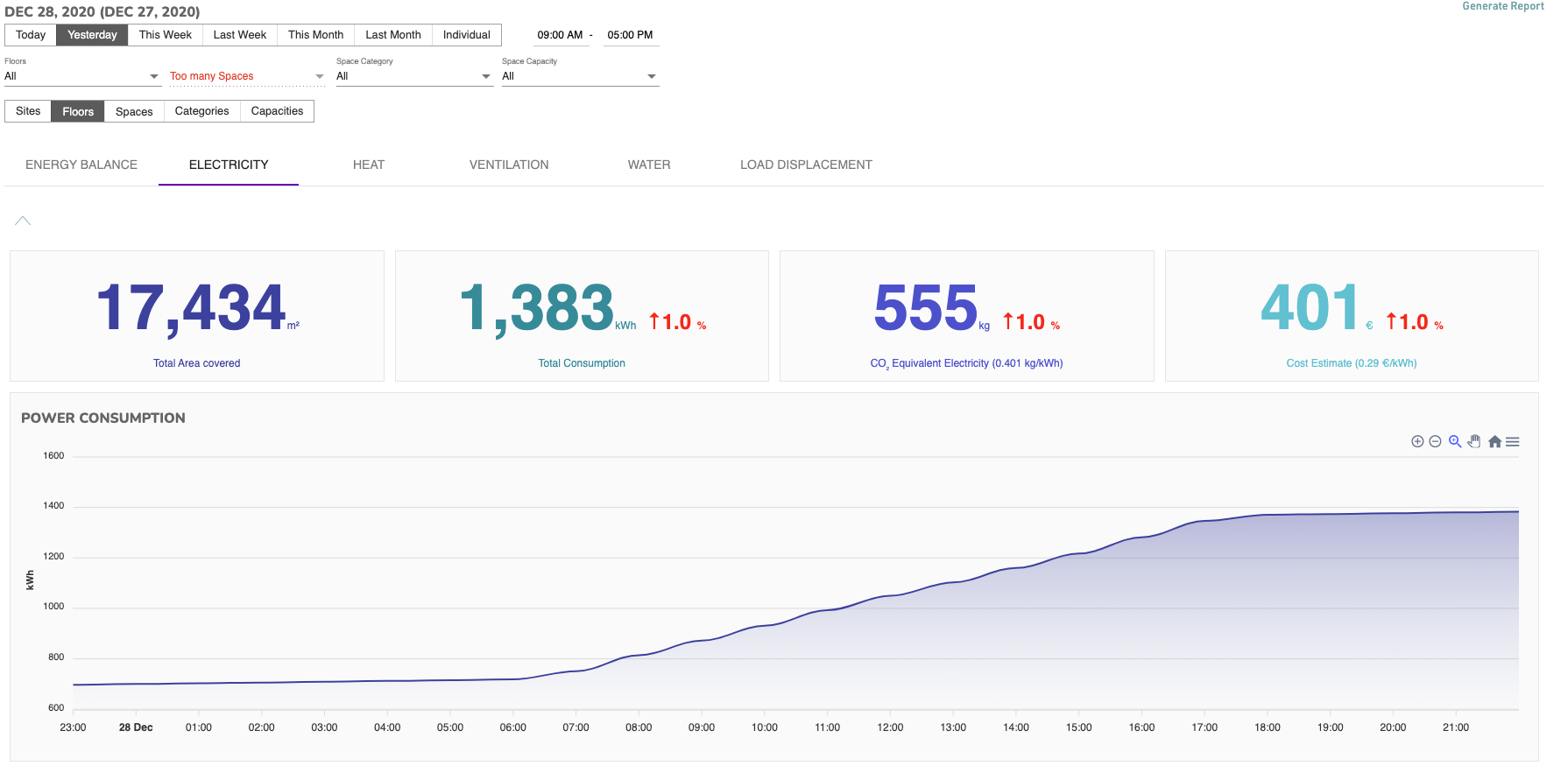
Extensive filter options are available for analyzing consumption data:
Desired and measurable types of energy
Time
Date
Time interval
Location
Building
Floor
Spaces
Room capacity
Exporting or transferring data to enterprise resource planning systems, for example for creating utility bills, is made easy with the MazeMap Workplace API.
If the meters are entered in the digital twin (Building Information Model) of the property, location-based services are possible. For example, the position of a meter in the building can be displayed on a digital floor plan for employees or tradesmen in the event of maintenance.
Conclusion
For companies, investing in an intelligent metering infrastructure pays off in the long term. Cost reduction, climate protection, increased competitiveness and, last but not least, the resulting positive image are the most important factors.
As a Smart Buildings IOT Challenge Finalist 2020, Thing Technologies offers a scalable solution for automated reading, analysis and optimization of energy consumption on a broad customer base.
(electricity_meter_outdated.jpg)
Thing Technologies offers a wide range of solutions to improve energy efficiency, reduce costs and thus make a decisive contribution to climate protection.
Legal framework
The German government has defined the energy transition as "central to a secure, environmentally friendly and economically successful future". The energy transition refers to the switch in energy supply from fossil and nuclear fuels to renewable energies and an increase in energy efficiency.
In order to successfully shape the energy transition, all components of the energy system must be restructured. This includes the expansion of the electricity grids, the development of new storage systems and the use of intelligent grids - also known as smart grids.
When the Act on the Digitization of the Energy Transition (GDEW) came into force in August 2016, the Federal Ministry for Economic Affairs and Energy regulated the equipment and operation of intelligent metering systems, known as smart meters, in connection with the energy transition (Federal Ministry for Economic Affairs and Energy).
What are smart meters?
Smart meters are intelligent meters that can record, store, and transmit consumption data. The term "smart meter" is mostly used in connection with digital electricity meters. However, the same applies to water, gas, and heat meters.
Modern (digital) electricity meters record consumption at short intervals or even in real time. They thus provide an interface through which the raw consumption values can be read out frequently.
The MazeMap Workplace platform provides clarity.
If you want to increase your energy efficiency, you first need to learn something about your consumption. Annual meter readings are not enough here.
The solution lies in the use of a new meter infrastructure in conjunction with an intelligent digitization platform such as MazeMap Workplace.
A new metering infrastructure begins with the replacement of electricity meters with smart meters. The conversion is regulated by the GDEW timetable and, depending on consumption, must be completed by 2032 (Federal Network Agency (2020); Section 29 (3) sentence 1 MsbG). Replacement is possible at any time before then, at the latest with the regular meter change. This is regulated in the German Measurement and Verification Act (MessEG).
Standardized meter interfaces, e.g. S0 interface or MBus, and established transmission technologies, e.g. EnOcean, enable a high degree of flexibility and manufacturer independence.
Step by step
MazeMap Workplace supports its customers with specific requirements and use cases and provides recommendations for infrastructure measures. The analysis begins with the local conditions and an inventory of the existing infrastructure. This includes building management systems, the IT network, the Internet connection, the meters for the various types of energy, and the location of the meters in the building.
The meters are installed by the metering service provider or a qualified electrical contractor. The subsequent configuration and commissioning is carried out by MazeMap Workplace or a partner company.
Once the smart meters are installed and a communication channel to the internet has been established, consumption data can be continuously transmitted to the MazeMap Workplace Cloud. This makes the reading process fully automated.
The consumption values of all meters are first collected in the MazeMap Workplace database and then visualized in the portal or app. Individually configurable dashboards provide a comprehensive overview of the meter readings. The diverse requirements and interests of users are taken into account:
Current consumption (real-time data)
Consumption histories
Comparison of consumption values
Correlation diagrams with external data, e.g. weather data
Bibliography
Adolph, K. (2016, January 27). Energy transition: Definition & goals - the overview. Retrieved December 30, 2020, from: https://www.co2online.de/klima-schuetzen/energiewende/energiewende-definition-ziele-uebersicht/
Federal Ministry for Economic Affairs and Energy (2020). Smart meters: Intelligent metering systems for the energy transition. Retrieved December 30, 2020, from: https://www.bmwi.de/Redaktion/DE/Textsammlungen/Energie/smart-meter.html?cms_artId=882508
Federal Network Agency (2020). Modern metering equipment/intelligent metering systems. Retrieved December 30, 2020, from: https://www.bundesnetzagentur.de/DE/Sachgebiete/ElektrizitaetundGas/Verbraucher/Metering/SmartMeter_node.html#FAQ717782
Act on Metering Point Operation and Data Communication in Smart Energy Networks of August 29, 2016 (Metering Point Operation Act - MsbG). Retrieved December 30, 2020, from: http://www.gesetze-im-internet.de/messbg/__29.html
Act on the Digitization of the Energy Transition of 29 August 2016 (Federal Law Gazette I p. 2034)
Industrial Internet Consortium (2020). Smart Buildings Challenge Summary Report. Retrieved December 30, 2020, from: https://www.iiconsortium.org/smart-buildings-challenge/Smart-Buildings-Challenge-Summary-Report-April-2020.pdf
Simons, K. (2020, June 30). Smart meters: Consumption digital and always in view. Retrieved December 30, 2020, from: https://www.co2online.de/modernisieren-und-bauen/smart-home/smart-meter-uebersicht/
Get started now with
MazeMap Workplace
Contact us today. We’ll get back to you shortly. You’re also welcome to schedule a demo right away.
Call us at
+49 (69) 566086792

No-obligation demo
Book an appointment now
You can count on MazeMap Workplace
Easy integration: Seamless integration into existing systems.

High usability: user-friendliness and intuitive operation.
Robust security standards: Maximum security for your data.