April 17, 2026 (updated) - 6 min read
Mobile Work: Definition, Opportunities, and Successful Implementation
Mobile working means that employees can choose where they work—whether from home, on the go, or in the office. What began as a stopgap measure during the pandemic is now an integral part of modern work models.
In this article: Definition, differences from working from home, benefits for companies, risks—and how to successfully implement it in practice.
by Ivan Escamilla
At a glance:
• Mobile work = location-independent work, legally distinct from working from home
• Benefits for companies: up to 50% reduction in office space, improved ESG metrics
• Risks: Company culture, creativity, and onboarding suffer when remote work is excessive
• Solution: A functional office + digital tools that facilitate navigation and booking
• 5 recommendations for getting started at the end of the article
Mobile Work vs. Working from Home:
What’s the difference?
"Home office" refers to working from a fixed workstation at home that must meet the requirements of the Workplace Ordinance. Mobile working, on the other hand, is location-independent—whether in a café, on the go, at a client’s site, or from home—and is not subject to specific equipment requirements.
In Germany, there is currently no legal right to mobile work. It requires an individual agreement, ideally in writing or as a company policy. In both cases, the employer remains responsible for occupational safety and data protection.
In practice, hybrid work models combine both forms: fixed home office days plus flexible mobile work depending on the task.
Aroom booking solution is recommended for managing desks and meeting rooms in a hybrid work environment.

Why Mobile Work Is the Norm Today
The pandemic has given office workers greater flexibility and autonomy—in terms of where they work, when they work, and their work-life balance. What began as a stopgap measure has become a long-term expectation: the majority of employees want to continue switching between working from home and the office in the future.
For companies, this means that the office of the future must be more attractive than working from home—not through mandatory attendance, but through genuine added value.
Benefits for Businesses:
Space, Costs, and ESG
Companies that allow hybrid work can reduce the amount of space needed for workstationsby up to 50%if they adopt flex desking—that is, a more flexible approach to workstations.
According to the M.O.O.CON study, this is actually the single most effective measure for improving ESG performance. Even a 30% reduction in leased space offers companies enormous potential to cut costs while significantly reducing their CO2 emissions.

Risks and Challenges of Remote Work
If, after the pandemic, too many employees continue to work from home too often or exclusively, this can have a negative impact over time on corporate culture, turnover rates, certain aspects of productivity, innovation, and, consequently, competitiveness. For example, it is more difficult to fully harness a team’s creative potential when everyone is working remotely. When people meet in person, team communication is easier and, as a result, more effective and efficient.
Video conference workshops where the dynamic just doesn’t seem to take off. In in-person workshops, on the other hand, we still see much more interaction and participation. In addition, integrating new colleagues into a team can be much more difficult remotely. After all, team and corporate culture thrive on colleagues spending significant time together in the same space. They also run into each other in the hallway, in the break room, or make plans for lunch. If this doesn’t happen enough, even the loyalty of long-time employees can wane. This means that maintaining and developing the corporate culture becomes significantly more difficult.
Online collaboration alone cannot permanently replace face-to-face conversations and direct interaction. Reading or writing “LOL” is not the same as laughing together. To retain and attract employees in the future, companies must now “more than ever redefine their attraction and retention strategies and build a value proposition that takes into account the entirety of employees’ lives,” according to a McKinsey recommendation2 from March 2022.
Return to the Office:
Why Mandatory On-Site Work Is the Wrong Approach
Mandatory in-office attendance is the wrong approach. Anyone who believes they can take away the flexibility their employees have learned and rely on mandatory in-office days is taking a huge risk—for companies and their top talent. We currently have an employee’s market here in Germany as well, and this carries the clear danger that good employees, in particular, will look for new opportunities. They will seek out employers who continue to offer them autonomy, work-life integration, and thus their trust.
In the US, for example, more than 4.3 million people voluntarily quit their jobs last December, according to the US Bureau of Labor Statistics. This is just below the record figure from November 2021 and there are significantly more current job vacancies (10.9 million) than new hires (6.3 million). According to a survey by McKinsey, the main reason for accepting a new position was "workplace flexibility".
Implementing Remote Work Successfully: Boosting Intrinsic Motivation
Companies must strengthen employees’ intrinsic motivation to want to return to the office. In other words, there must be added value for them there—value that, from the employees’ perspective, makes it worthwhile to invest the time and money required to come into the office. The office must support employees in their work, and being there must be a positive experience for them. There is hardly anything worse than making the trip to the office only to then collaborate with others via video conference from there. What is needed, therefore, is a consolidation—less space, but space that must be much better designed. Employees need to experience their workplace in a new way.
Above all, a holistic approach is key. It’s about making adjustments in various areas. Many disciplines come into play here: leadership teams, HR, IT, and real estate management. It’s about social experiences through incentives and events for employees, as well as providing diverse spaces tailored to specific tasks, stylish furniture, and great tools for collaboration and streamlining daily work organization. In such a comprehensive concept that meets these evolving needs, digitalization can offer highly effective support. Ultimately, everything revolves around two key points: First, you must ensure that the office does not become dysfunctional, and second, that there are plenty of positive incentives. It is important to understand that positive incentives only help if the office is functional—in a dysfunctional office, stylish furniture is of no use.
The Dysfunctional Office:
The Most Common Pitfalls
The shift from fixed workstations to flexible workstations—which is necessary to implement space consolidation—poses significant challenges for employees. Familiar office routines are being disrupted. How do I know if I have a workstation? With desk booking software, desks can be reserved via an app—employees can see in real time which spaces are available.
How long will it take me to find him? Who else will be in the office, and where? Where should I put my things? Where is the nearest printer? Which collaboration spaces are currently available? Where is the help desk in the building I'm in today?
Even the coffee machine, which I rarely use or have never used, can become a frustrating experience, just like unfamiliar conference technology. These minor irritations and small obstacles can quickly make the office experience so negative that employees no longer want to come in. The larger the office space, the higher the risk.

How Digital Tools Support Remote Work in the Office
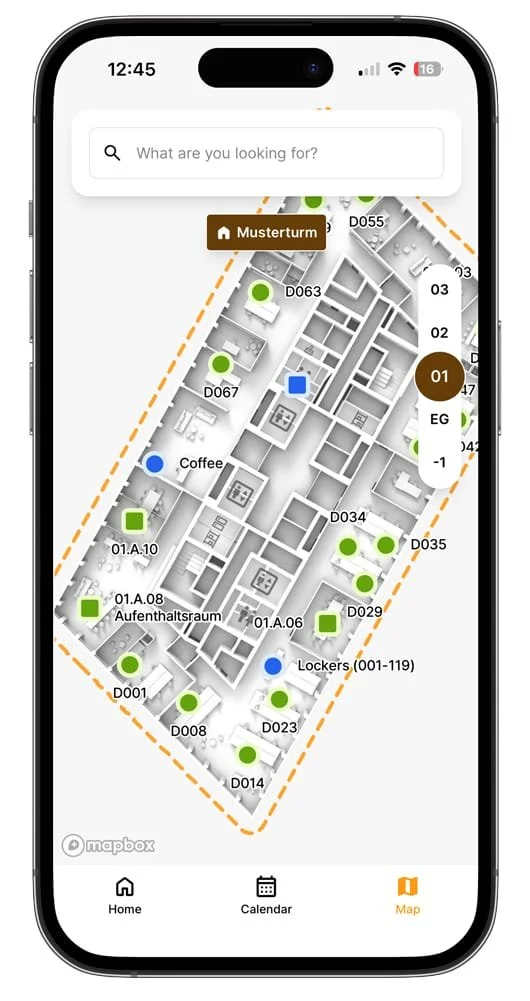
Employees who use the office space are helped to find their way around by digital office assistants, e.g. an app that they always have with them. They can use it to find their workstation for the morning, the right meeting room for brainstorming in the afternoon and then the individual office for the most important customer calls. The laptop can also be stowed away in the locker quickly booked via the app if you want to meet colleagues for a quick after-work drink - everything is adapted to changing needs throughout the day.
The app also helps me find colleagues and make appointments with them, search for the help desk, printer or booked meeting room for the next appointment. Without having to walk long distances, I can see which rooms, desks, phone booths etc. are now available for me and my team members and I get quick help with orientation thanks to the indoor navigation function. I can also find my way around buildings that I rarely visit. This becomes all the more relevant the larger the office space or campus I move around. Basically, an app like this helps me in office spaces in a similar way to how maps applications support me in everyday urban environments. Navigating is learned, saves time and can perhaps also reduce the number of notorious latecomers at meetings. Interactive displays on the floor and in meeting rooms allow orientation even without an app.
Supported by these smart assistants, stumbling blocks and frustration factors are avoided right from the start. This allows employees to focus on the benefits of the new workplace concept and significantly increases the overall attractiveness of the space. The new working environment loses its fright and becomes a place of encounter. And the more people come into the office for these encounters, the livelier it becomes and the more likely it is that intrinsic motivation to work in the office will increase. A self-reinforcing effect sets in.
Every newly introduced technology initially encounters an adoption barrier. Not all employees are happy about having to learn how to use it. When companies provide their employees with a different app for every support function—workplace booking, catering, lockers, menus, etc.—many of these apps will never generate sufficient value and will simply remain unused. Instead of controlling many individual functions via different apps, we at MazeMap Workplace provide companies with an all-in-one solution. Employees only have to learn one new technology and can use it to support them in a wide range of everyday work tasks.
Most of our customers want to implement desk sharing and therefore start with the desk booking feature. Over time, they gradually roll out additional support features to their employees in a modular way, without increasing the complexity for them. The onboarding process and usability remain consistent—and always align with the company’s corporate design. Only in this way can the technology make a lasting contribution to employer branding.
Recommendations for Implementing Remote Work
Five things companies should keep in mind:
Don’t be too sure which workplace model will be best after the pandemic. Plan for the possibility of being wrong and the need to make constant adjustments.
Use mandatory guidelines as little as possible. Let office users decide where and when they work. Focus on fostering the intrinsic motivation that drives people to come into the office. The goal is to bring team members back together and into the office.
Focus on strategies and techniques that help maintain high office occupancy rates and, when in doubt, avoid providing too much office space. After all, high office occupancy has many positive effects.
You should prioritize employee self-organization over centralized directives by putting the necessary technologies in the hands of your employees.
Use detailed data provided by versatile building digitalization platforms as a foundation. This allows you to continuously assess and analyze actual needs and, as a result, optimize them.
Conclusion: Mobile working is a great opportunity
The current situation presents a major opportunity—and it deserves our full attention. Companies that take the time to fully understand and address the issue can offer their employees greater flexibility, which significantly enriches their lives. In addition, we can manage with much less office space, which we can design much more effectively. This has a positive impact on employees, CO2 emissions, and the bottom line. It should be clear that this isn’t simply about introducing a workspace booking app. Only a holistic approach—which, of course, must be supported by comprehensive and flexible technology—allows companies to turn this opportunity into a real competitive advantage.
Would you like to find out more about how to successfully implement hybrid working in your offices?
Download our white paper,“Modern Space Management: The Perfect Balance of Efficiency and Workplace Experience,” today!
Frequently asked questions
-
Mobile working means that employees can choose where they work—regardless of whether they have a fixed office or home office. It includes working while on the go, at a client’s location, or from abroad.
-
Working from home is tied to a fixed workspace in the home and is subject to workplace regulations. Mobile work is location-independent and more flexible, with no fixed equipment requirements.
-
No, there is currently no legal right to remote work in Germany. It requires an individual agreement between the employer and the employee.
-
Space savings of up to 50%, lower rental costs, improved ESG metrics, and higher employee satisfaction—provided the office is designed to be both functional and attractive.
Are you
curious?
Contact us today using the form. We’ll get back to you shortly.
Or book a demo appointment directly :
Free & no obligation

Tailored specifically to your situation, rather than a standard demo
Book a no-obligation demo today!

Lisa Pfützner
Workplace Strategist

Give us a call
+49 69-566086786