April 14, 2026 – 5 min read
Workplace Management Software for Hybrid Companies: What Matters Most
Workplace management is no longer a niche topic. For companies with hybrid work models, it has become a core operational task—and, at the same time, one of the most complex.
Anyone responsible for office space is familiar with the underlying problem: fewer people are in the office each day, while rent costs remain the same or even rise. At the same time, the pressure to use space more efficiently is growing.
This guide explains what modern workplace management entails today, which roles are involved—and what you should look for when choosing a software solution.

Head of Marketing
What is Workplace Management?
Definition & Scope
Workplace management refers to the strategic planning, organization, and management of work environments with the goal of simultaneously optimizing efficiency, productivity, and employee satisfaction.
Specifically, workplace management includes:
the needs-based management of desks, meeting rooms, parking spaces, and other resources

the analysis and optimization of actual land use based on sensor data
the integration of digital booking systems into existing IT infrastructures
coordination between CREM, HR, IT, and Workplace teams
Modern workplace management software combines desk sharing, room booking, parking management, and usage analytics into a single centralized platform. This enables large companies to efficiently organize hybrid work models, utilize their office space according to demand, and provide employees with easy access to all bookable resources.
Distinction from Facility Management:
Facility management focuses on the building itself—from maintenance and cleaning to technical infrastructure. Workplace management, on the other hand, focuses on how people use the space within that building: from analyzing booking patterns and occupancy rates to implementing shared-space concepts and optimizing the employee experience.
In larger organizations, workplace management is often implemented as part of an Integrated Workplace Management System (IWMS) —a software solution that brings together space management, booking systems, analytics dashboards, and IT integration on a single platform.
Why workplace management in
hybrid office
Before the pandemic, workplace management was relatively simple: assigned desks, predictable occupancy, and clear structures. That model no longer works today.
Your employees come into the office on different days. Teams are having trouble coordinating. Meeting rooms sit empty even though they’re booked, and somewhere in the building, someone is searching in vain for a quiet place to take a call. At the same time, you’re expected to make decisions about downsizing or expiring leases without reliable data.
The pressure is coming from several sides:
C-level executives expect cost reductions and clear KPIs
HR wants to ensure employee satisfaction
IT requires secure, maintainable, and compatible systems
Workplace teams must validate sharing policies and manage departmental complaints
No one wants to bear the risk of making the wrong decision alone. That is precisely what makes workplace management such a complex, collective issue.
How Modern Workplace Management Works
Effective workplace management in a hybrid office is based on three core operational elements:
1. Booking systems that are actually used
If booking a desk takes longer than 30 seconds or requires a separate login, the tool won’t be used. Booking systems must therefore be integrated into applications that are already used on a daily basis—primarily Microsoft Outlook and Teams. A native Outlook add-in for room bookings is not a nice-to-have, but a prerequisite for high adoption and usage. If, for example, additional booking apps are needed for parking management, they should be intuitive and time-saving.
2. Actual usage data instead of estimates
Head-to-desk ratios based on assumptions or booking data alone remain speculative. Sensor-based utilization analyses show you how your spaces are actually being used. Sensors also enable efficiency-boosting auto-checkout functions: No-shows are automatically detected, and unused spaces are released. This ensures that booking data aligns with actual resource availability. This data forms the basis for well-founded right-sizing decisions that you can confidently present to C-level executives and CFOs.
3. Dynamic space planning instead of rigid structures
When a department grows or usage patterns change, your space plan must be able to adapt flexibly. Effective workplace management enables continuous, needs-based, and data-driven adjustments.
Which providers offer workstation, room, and parking spot reservations on a single platform?
Companies can organize workstation reservations, room reservations, and parking management either through multiple standalone solutions or via a centralized workplace management platform. An all-in-one solution reduces administrative overhead, eliminates duplicate data, and provides employees with a unified user interface for all their day-to-day office tasks.
MazeMap Workplace combines desk booking, room booking, and parking management into a single platform. Employees can book workstations, meeting rooms, and parking spaces as needed, while workplace and facility teams can centrally analyze booking and usage data. Additional features such as indoor navigation, digital lockers, access control, and sensor-based analytics are particularly beneficial for large companies and those with multiple locations.
When choosing a platform, you should make sure that:
- all necessary resources can be managed centrally,
- Roles and posting rules can be customized,
- the solution supports multiple locations and languages,
- bookings and actual usage can be analyzed together,
- it can be integrated into existing systems such as Microsoft 365.
Ready to optimize your space efficiency and workplace experience?
If you’re in charge of office space at a hybrid company, you don’t need more guesswork—you need reliable data and a platform that best supports your employees’ daily work.
MazeMap Workplace offers you one of the most comprehensive all-in-one platforms on the market. Companies in 28 countries rely on MazeMap Workplace and have measurably improved both space efficiency and employee satisfaction in over 1,000 offices worldwide.
Workplace Management Software:
What to Look For
Not every platform delivers on its promises. In practice, these criteria are what really make the difference:
Microsoft 365 Integration
If your company relies on Outlook and Teams, your workplace tool must integrate natively with them—without requiring a separate login or causing any disruption. Desk booking, room reservations, and resource management should be possible directly from within Outlook. Tip: Have your IT team verify security and data protection compliance in advance.
Sensor-based analytics — more than just booking data
Booking data reflects intended usage, while sensor data reflects actual usage. To make informed right-sizing decisions, you need both—ideally in a dashboard that can be seamlessly integrated into C-suite reporting.
Space Efficiency and Sustainability
Less space doesn’t just mean lower rental costs—it also means reduced energy consumption and lower CO₂ emissions. Modern workplace management solutions also provide you with the data needed for sustainability reports and help you meet regulatory requirements (e.g., ESG reporting).
Orientation and Navigation in the Building
Especially in large companies with multiple floors or locations, it is crucial to be able to quickly locate points of interest, colleagues, and resources. Interactive maps and navigation features reduce search times and measurably increase satisfaction and productivity.
Scalability and Contract Transparency
When you choose a workplace management solution, you’re entering into a medium- to long-term commitment with a provider. Make sure the contract terms are fair and that the solution will still be a good fit for your company as it grows and evolves.
Data Protection, GDPR, and Hosting
Depending on its range of functions, workplace management software processes personal data, booking information, and, where applicable, location data. Companies should therefore review what data is actually collected, where it is stored and processed, and which subcontractors are involved.
Key selection criteria include GDPR-compliant processing, a data processing agreement, transparent retention periods, a differentiated role and access rights management system, and appropriate technical and organizational safeguards. For companies operating internationally, it is also important to determine whether data locations and access rights can be configured in accordance with their own compliance requirements.
MazeMap Workplace is GDPR-compliant and ISO 27001-certified. However, companies should still tailor the specific requirements for hosting, data residency, and internal data protection policies to their individual needs as part of the implementation process.
Frequently asked questions
-
Workplace management refers to the strategic planning, organization, and optimization of work environments—with the goal of using space efficiently while ensuring productivity and employee satisfaction. In a hybrid context, it encompasses digital booking systems, usage analytics, sharing concepts, and integration with existing IT infrastructures.
-
Facility management handles the building: maintenance, cleaning, and technical infrastructure. Workplace management focuses on people and how they use the space: bookings, occupancy analysis, space planning, and the employee experience. The two areas overlap—but workplace management is more data- and user-centric.
-
An Integrated Workplace Management System (IWMS) is a software platform that combines space management, booking systems, maintenance management, and analytics into a single integrated solution. For large companies with hybrid models, it serves as the technical foundation for modern workplace management.
-
Start with actual occupancy data, not estimates. Track actual occupancy for at least 4–6 weeks. Most hybrid companies find that on peak days, 60–70% of employees are in the office at the same time—which allows for a ratio of 0.6–0.7 desks per person. The optimal ratio depends on the industry, company culture, and location.
-
They do—if the tool is intuitive and integrated into familiar work environments. Systems that run natively in Outlook and offer a user-friendly mobile app achieve significantly higher adoption rates than standalone applications. The effort required for migration and onboarding are critical success factors. Nevertheless, if there is no shortage of resources, booking is an unnecessary burden. However, if there is a shortage, booking solutions provide employees with the planning certainty they need.
-
Desk-sharing software is suitable for large companies if it not only allows individual workstations to be booked but can also accommodate complex organizational structures, multiple locations, and different booking rules. Other important features include scalable role and permission management, single sign-on, interfaces to existing IT systems, and reliable analytics on actual space utilization.
MazeMap Workplace combines workstation booking with sensor-based usage analytics and other resources such as meeting rooms, parking spaces, and lockers. Employees can flexibly book available workstations and, if they wish, see which colleagues are working nearby. At the same time, workplace teams gain the data they need to plan space according to demand and reduce unused capacity.
Especially in hybrid work models, desk sharing should not be viewed in isolation. A solution offers the greatest benefit when workstation reservations, room management, parking management, and space analysis are integrated.
Latest Posts
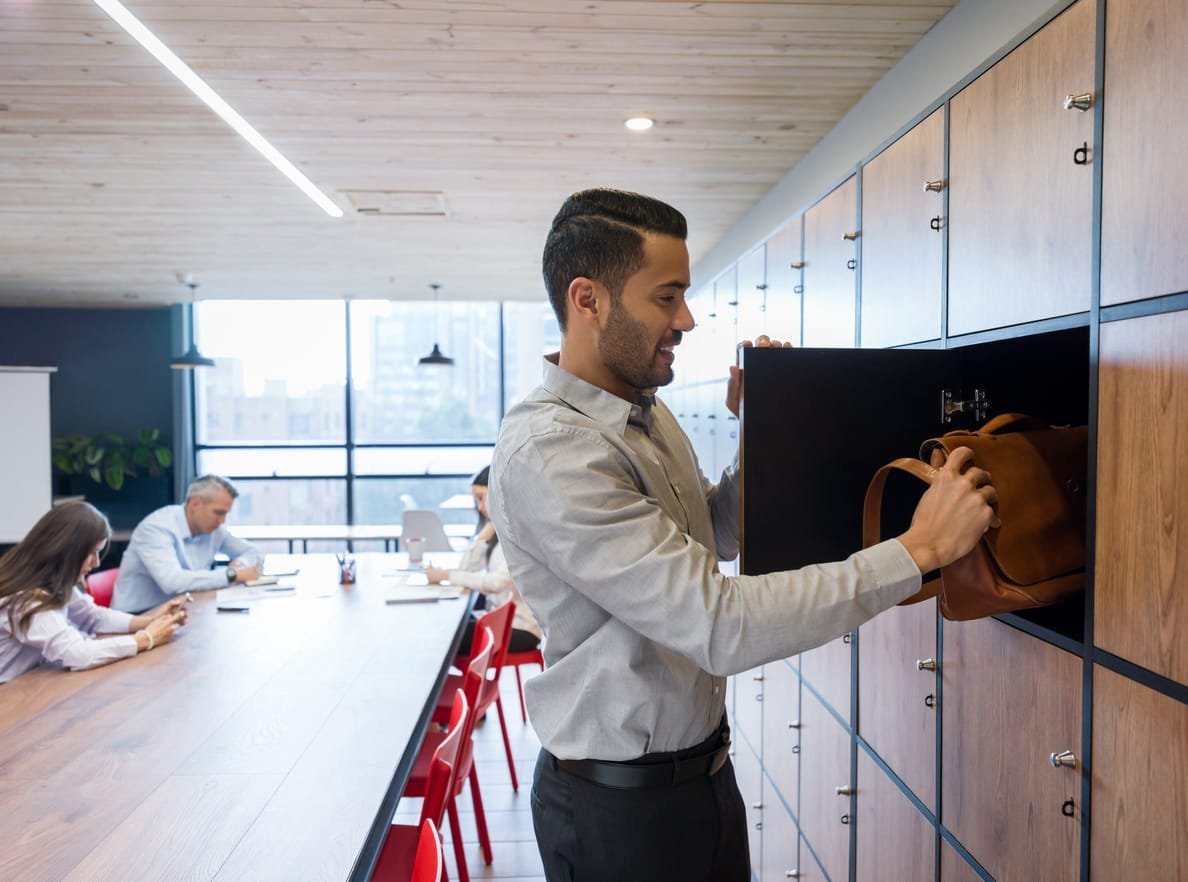
Smart Lockers in the Office: How Digital Lockers Work for Hybrid Work
Smart lockers are replacing traditional lockers in the hybrid office. Learn how digital lockers work, the benefits they offer in terms of space efficiency and employee experience, and what you should consider when implementing them.

Digital parking space management: How to finally make efficient use of unused space
For many employees, finding a parking space in the morning is a daily source of stress—even though there is often unused space available. The problem is usually not a lack of parking spaces.

Desk Sharing in the Office: Why It Often Fails—and How to Make It Work
Desk sharing —that is, the flexible sharing of workspaces in the office—has become established in German companies as a response to hybrid work models.
Are you
curious?
Contact us today using the form. We’ll get back to you shortly.
Or book a demo appointment directly :
Free & no obligation

Tailored specifically to your situation, rather than a standard demo
Book a no-obligation demo today!

Lisa Pfützner
Workplace Strategist

Give us a call
+49 69-566086786